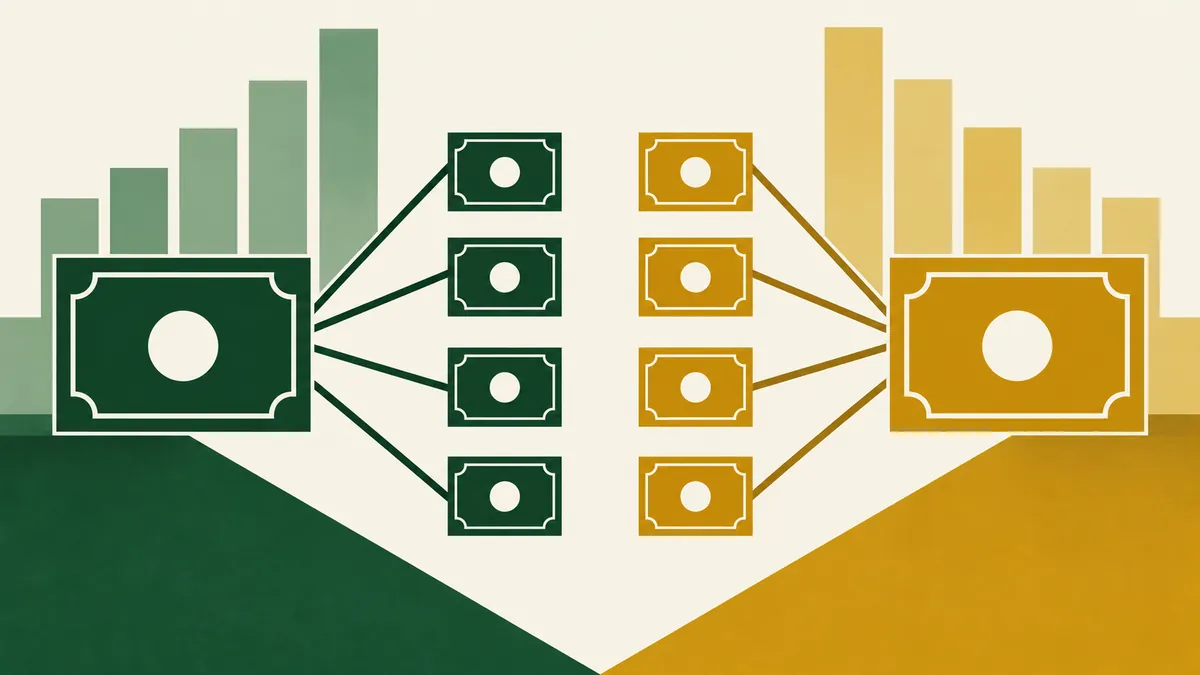
A stock split changes the number of shares outstanding but not the company's underlying value. Yet the headlines treat splits like a rocket fuel — and reverse splits like a funeral. Both reactions overshoot the truth.
Forward Splits
In a 2-for-1 forward split, your 100 shares at $200 become 200 shares at $100. Your total value is unchanged. The company has decided the lower price will attract more buyers (especially retail) and broaden ownership.
Reverse Splits
In a 1-for-10 reverse split, your 100 shares at $1 become 10 shares at $10. Total value unchanged. Most reverse splits happen to avoid getting delisted from an exchange that requires a minimum price, which is why the market reads them as a warning sign.
What Changes for Cost Basis
Total cost basis stays the same. Per-share basis adjusts inversely to the split ratio. Our Stock Cost Basis Calculator can re-compute after a split if you enter the post-split share count.
What Doesn't Change
- Market capitalization
- Your percentage ownership of the company
- The company's earnings or assets
- Tax consequences (splits are non-taxable events)
Why Splits Were a Bigger Deal Pre-2010
Round-lot trading (100-share blocks) used to matter for commissions and liquidity. With fractional shares and zero-commission trading, the practical benefit of a forward split is largely gone — though it still drives short-term retail enthusiasm.
Bottom Line
A split is mostly cosmetic for long-term investors. Adjust your basis records and move on. If a reverse split was needed to stay listed, that's usually the more important signal.
Frequently Asked Questions
What actually happens when a stock does a 2-for-1 split?
In a 2-for-1 forward split, your existing shares double in number while the price per share is cut in half, so your total investment value is unchanged. Companies generally do this to make each share more affordable and to broaden ownership, particularly among retail investors. Your percentage ownership of the company and its underlying earnings and assets remain exactly the same.
Is a reverse stock split a bad sign for a company?
A reverse split, for example 1-for-10, doesn't change the total value of your holding, but it's often viewed negatively because companies frequently use it to avoid being delisted from an exchange for trading below a minimum required price. That said, the split itself doesn't change the company's underlying business — it's typically the reason behind it that investors should treat as a warning signal. Researching why a specific reverse split occurred is generally more useful than assuming the worst automatically.
Does a stock split trigger a taxable event or change my cost basis?
A stock split is a non-taxable event, and while your total cost basis stays the same, the per-share cost basis adjusts inversely to the split ratio — for example, a 2-for-1 split halves your per-share basis while doubling your share count. It's important to update your own records or verify your broker's adjusted numbers so you don't miscalculate gains or losses when you eventually sell. Tax questions specific to your situation are best addressed with a tax professional.
Run the numbers yourself
Plug your own inputs into our free calculators — no signup.