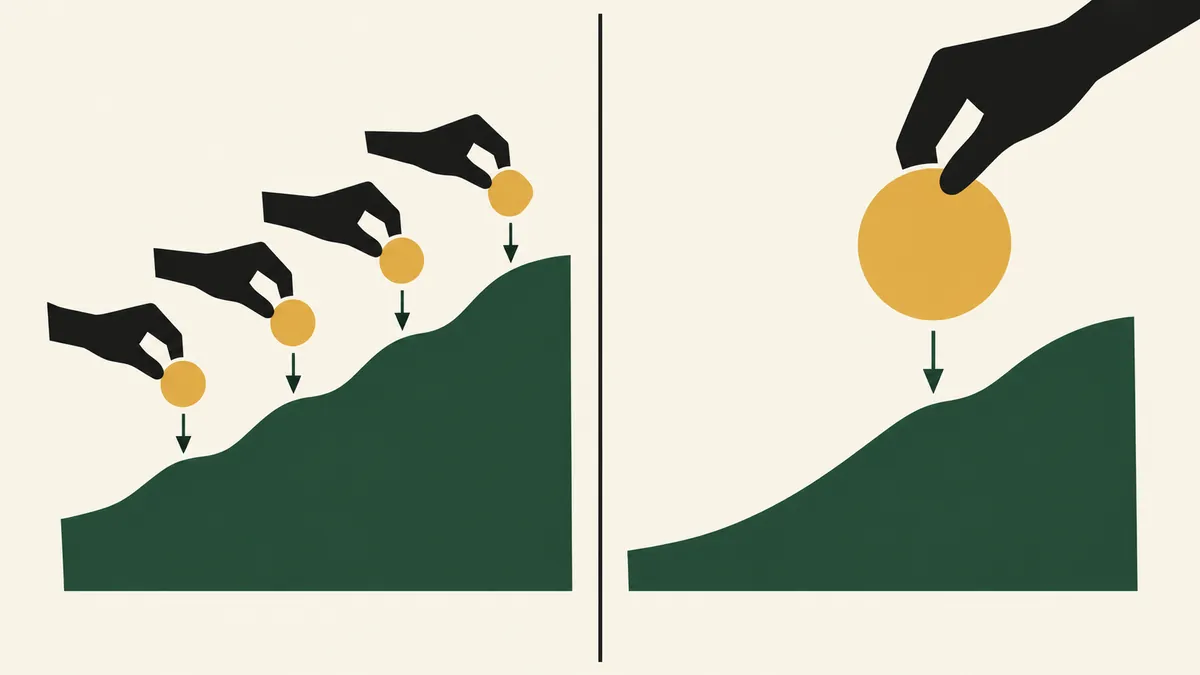
You inherit $50,000. Do you invest it all today, or spread it over 12 months? This is the classic lump sum vs dollar-cost averaging (DCA) question, and the answer is more nuanced than either side likes to admit.
What Each Strategy Actually Does
Lump-sum investing puts the full amount to work immediately. Time in the market starts on day one.
Dollar-cost averaging invests fixed amounts on a regular schedule (e.g., $4,167 a month for 12 months). Your average purchase price smooths out across whatever the market does.
What the Data Says
Vanguard's well-known study found that lump-sum investing beat 12-month DCA roughly two-thirds of the time over rolling 10-year periods. The reason is simple: markets rise more often than they fall, so getting invested sooner usually wins.
But "usually" is not "always". In the years lump-sum lost, it sometimes lost by a lot — anyone who lump-summed in October 2007 spent the next 18 months underwater.
When DCA Is the Right Call
- You are nervous about timing. Psychology matters: a strategy you abandon at the bottom is worse than a mediocre one you stick with.
- The cash is already committed. Most people DCA from every paycheck whether they realize it or not. That is dollar-cost averaging by default, and it is fine.
- You suspect markets are stretched. DCA gives you a behavioural safety net — though no one reliably knows when markets are stretched.
When Lump Sum Is the Right Call
- You have a long time horizon. The longer you'll be invested, the more "time in the market" matters and the less the entry point matters.
- You will not panic-sell. If you can ride out a 30% drawdown without flinching, the math favors lump-sum.
- The cash is otherwise sitting idle. Cash drag — sitting on un-invested money — is itself a risk.
A Practical Middle Ground
Many advisors suggest lump-summing into bonds and DCA-ing into stocks, or splitting the difference (half now, half over six months). It is not optimal in expectation, but it can be optimal for you if it keeps you invested.
Try It Yourself
Plug your numbers into the Dollar Cost Averaging Calculator — the chart shows both strategies side by side. Then read The Power of Compound Interest to understand why getting invested at all is the real win.
Bottom Line
In a typical year, lump-sum wins. In a typical bad year, DCA wins. Pick the one you will actually stick with — that decision matters more than the strategy itself.
Frequently Asked Questions
Is it better to invest a lump sum all at once or spread it out over time?
Historically, investing a lump sum immediately has outperformed spreading it out through dollar-cost averaging (DCA) in roughly two-thirds of rolling periods, mainly because markets rise more often than they fall. However, this is a tendency, not a guarantee — in bad years lump-sum investing can underperform DCA by a wide margin, so there is no single answer that's always correct. Investing always carries risk, and the right choice generally depends on your time horizon and comfort with volatility.
What is dollar-cost averaging?
Dollar-cost averaging (DCA) means investing a fixed amount of money at regular intervals, such as monthly, rather than all at once. This smooths out your average purchase price across market ups and downs and can reduce the psychological difficulty of investing a large sum right before a downturn. Many people already do a version of this automatically through regular paycheck contributions to retirement accounts.
When does dollar-cost averaging make more sense than investing a lump sum?
DCA can make more sense when an investor is nervous about market timing, since spreading out purchases provides a behavioral safety net that may help them stay invested rather than sell in a panic. It's also a natural fit when cash becomes available gradually, such as through paychecks, rather than as a single windfall. Choosing the approach an investor is more likely to actually stick with is generally considered more important than the small mathematical edge either strategy may offer.
Does dollar-cost averaging guarantee better returns?
No, dollar-cost averaging does not guarantee better returns; it is primarily a risk-management and behavioral tool rather than a way to boost expected long-term performance. Comparisons with lump-sum investing generally show lump-sum wins more often over long horizons because markets tend to trend upward over time. Because all investing carries risk of loss, investors uncertain which approach fits their situation may want to consult a financial professional.
Run the numbers yourself
Plug your own inputs into our free calculators — no signup.